The Hill That Keeps Its Secrets: Castles, Campfires and a Pub at the Heart of Mow Cop
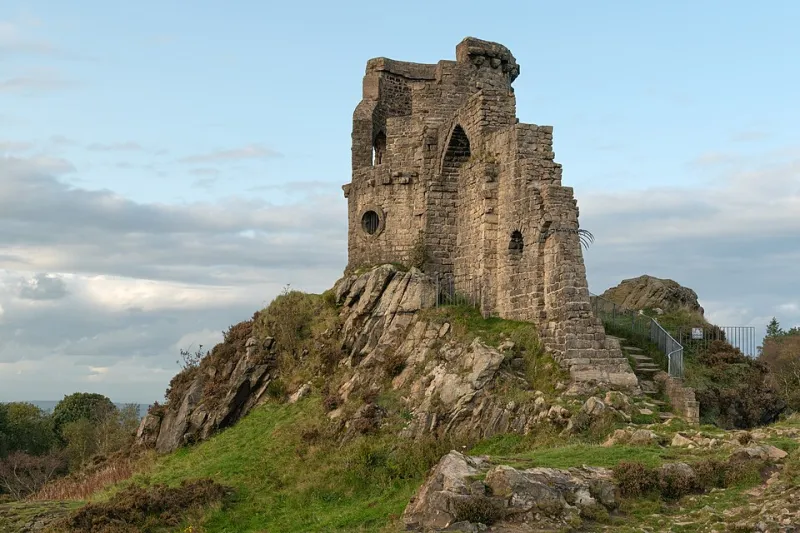
Photo: Dominic Nelson, CC BY-SA 4.0, via Wikimedia Commons
There are hills that simply sit in a landscape, and then there is Mow Cop. It rises sharply between Cheshire and Staffordshire, a stubborn lump of gritstone with a castle on top that looks as though it has been there since the Middle Ages. It hasn't. And that is only the first of the hill's small deceits.
From the windows and garden of Mow Cop Inn, the story of this place is laid out like a map: the folly on the ridge, the paths that thread through the trees, the rooftops of the villages below. You can see why people have been drawn here for centuries. Not just for the view, though the view is very good. For the sense that this is a place where things happen.
A Castle That Was Never a Castle
Mow Cop Castle is the sort of landmark that invites wild guesses. Smugglers' hideout? Ancient fortification? A romantic ruin left over from some forgotten war? The truth is more domestic and, in its own way, more charming. The castle was built in the 1750s as a folly for Randle Wilbraham of Rode Hall. It was a piece of landscape theatre, designed to look old and romantic from a distance. A mock ruin, built to be admired.
Over the years it has been claimed by folklore. Stories have attached themselves to it like ivy. There are tales of lovers, tales of hidden passages, tales of the hill being a meeting place long before the stone tower arrived. None of that matters quite as much as the fact that the castle has become a symbol. It is the thing you look for when you are driving home. It is the thing you point out to visitors. It is the reason a lot of people first pull on their boots and head up the hill.
And the pub sits below it all, not quite in the middle of the hill but certainly in the middle of the story. A place to wait out a shower, to warm up after the climb, to ask the question that every good landmark inspires: what is that, and why is it there?
When the Hill Became a Pulpit
If the castle is Mow Cop's romantic side, the camp meetings are its radical side. In the early nineteenth century, this hill became a place of open-air worship. Hugh Bourne, a local carpenter and Methodist, helped organise a camp meeting here in 1807. People came from across the region to sing, pray and listen to preaching in the open air. The movement that grew from those gatherings became Primitive Methodism.
It is easy to forget how strange and brave that must have been. These were not genteel garden parties. Camp meetings were noisy, emotional, hugely popular and viewed with suspicion by the established church. Mow Cop's shape helped. The hill forms a natural amphitheatre, a place where a crowd can gather and a voice can carry. The wind might have been fierce and the ground muddy, but the hill gave the meetings a stage.
Those gatherings left a mark on the hill that you can still feel. Not in bricks and mortar, but in the knowledge that this landscape has been used for something more than a nice view. It has been a place of argument, faith, community and change. The castle may be the postcard image, but the camp meetings are part of the hill's soul.
The Pub in the Middle of the Story
Mow Cop Inn is not a museum. It does not have glass cases or interpretation boards. What it has is a fire, a kitchen, a few tables and a steady stream of people who have come up the hill for one reason or another. Walkers. Cyclists. Families. Locals who know which corner is warmest. People who have driven out from the towns below because they wanted a proper pub with a proper view.
The inn is a custodian of the hill's tales in the simplest way: by being a place where they get told. You hear the castle stories at the bar. You hear about the camp meetings from someone whose family has been in the area for generations. You hear about the weather, the paths, the best route down in the dark. A pub like this does not invent local history. It hosts it.
That is the thing about a hilltop pub. It becomes a natural gathering point, just as the hill itself has always been. The camp meetings gathered people. The castle drew sightseers. The inn feeds them, warms them and sends them home with a bit more of the story than they arrived with.
Why the Hill Still Pulls People In
Mow Cop is not the tallest hill in the country. It is not the most famous. But it has a peculiar pull. Part of it is the view, which stretches out over fields and towns and, on a clear day, feels bigger than it has any right to. Part of it is the castle, that strange mock ruin that has become as familiar as a church spire. Part of it is the sense of history, not polished and roped off, but mixed into the everyday life of the place.
And part of it is the pub. A warm room at the bottom of the path. A plate of something hearty. A pint. A chance to sit with the hill's stories for a while before heading back down to normal life.
So if you come to Mow Cop, do the obvious things. Walk up to the castle. Stand where the camp meetings once gathered. Look out over the border country. Then come back down, push open the door and take your place in the long line of people who have used this hill as a meeting place. The castle may be a folly, but the welcome is real.